Crimson on the Brick: A Wall-Box Safari from Westminster to the City
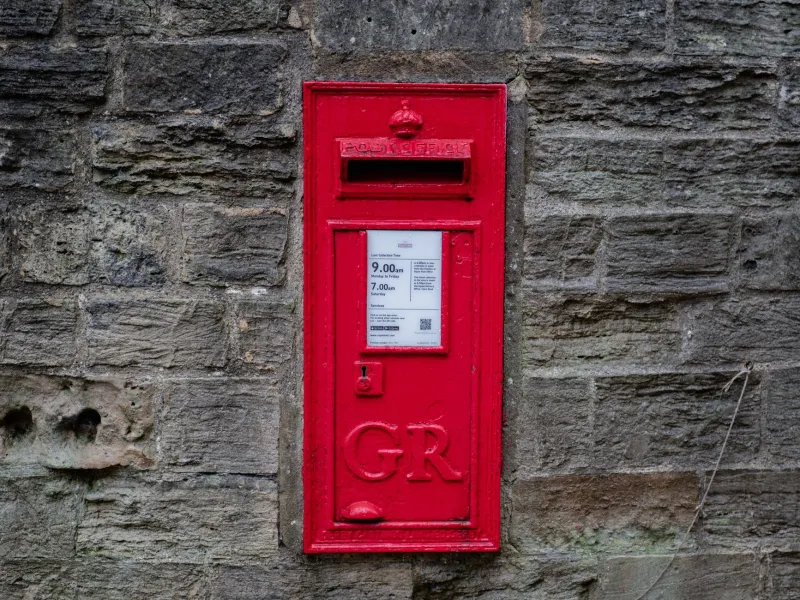
Pillar boxes get the photographs. Wall boxes get the job done. Set into a boundary wall or a stone pier, often at shoulder height and easily missed, they are the shy half of London's postal furniture — and they have been quietly collecting letters since before most of the city's buildings were tall enough to cast a shadow over them.
This walk runs from Westminster to the City in about two hours, at a stroll rather than a march. You will pass perhaps a dozen wall boxes if you keep your eyes up, and you will learn to tell your VR from your GR without breaking stride.
Why a box ends up in a wall
The first roadside letter boxes arrived in the 1850s, and London got its proper pillar boxes from 1857. But a pillar is a lump of iron standing in the way of prams, pub doors and delivery carts. Wall boxes solved a practical problem: narrow pavements, awkward corners, private estate walls and buildings where the freeholder would rather not have a red cylinder planted outside the front door.
So the Post Office screwed boxes to brick. Early examples were small, almost dainty, with a slot at the top and a door at the front. Later ones grew wider and squarer, and by the Edwardian period they were everywhere. Many were made for the London postal district specifically, which is why you sometimes see a plate reading 'London Chief Office' rather than a town name.
Stop one: Smith Square and the Westminster backstreets
Start at Westminster station and head up past the Abbey, then cut west into the Georgian grid around Smith Square. This is prime wall-box country: terrace walls, railings, mews corners. Look along Lord North Street and Cowley Street, and keep an eye on the side walls rather than the front doors.
The first box you find will probably wear a VR cypher — Victoria Regina — cast in the 1880s or 1890s. Notice how the red has weathered: chalky at the top, darker where rain runs. The familiar pillar-box red was standardised in the 1870s, but these older wall boxes have been repainted so many times that the shade is more of a family resemblance than an exact match.
Photo stop: get low and shoot along the wall so the box sits against brick, not sky. Overcast light is honestly better than sun here — the red goes flat in harsh glare.
Stop two: Victoria Street and the edge of Pimlico
Head east towards Victoria, then thread through the streets north of the station — Old Pye Street, Great Peter Street, the lanes that feel like a village that got lost. Pavements here are narrow enough to explain the entire wall-box programme on their own.
Look for a box set into a recess, with a manufacturer's plate below the slot. Andrew Handyside of Derby is the name you will see most often; McDowall Steven of Glasgow and W.T. Allen of London also supplied boxes that ended up in the capital. The plate gives you a date bracket, not a birthday — castings were batch-made, repaired, moved and repainted, and a box can easily outlive the wall it was first bolted to.
A word on the cypher. It tells you when the box was made, not when it stopped working. An Edward VII box was still collecting letters in the 1960s, and plenty of George V boxes are in daily use in 2026. That is part of the pleasure: you are looking at working antiques.
Stop three: Fleet Street's tight corners
Cut down to the river and cross at Embankment, or walk the Strand if the tide of tourists allows. Either way, aim for Fleet Street, where the buildings lean in and the pavement disappears under your feet.
Near St Dunstan-in-the-West, and again towards Chancery Lane, you will find wall boxes set into stone piers and recessed doorways. Some carry a GR cypher — George V — and a few have the small, almost apologetic proportions of the early 1900s. This is also where you start seeing boxes that have been repainted so often the lettering has softened, like a sign that has been sanded by a century of thumbs.
Photo stop: a close-up of the cypher with the maker's plate in the same frame. Use your phone's macro mode and brace against the wall. The contrast between crisp cast iron and crumbling stone is the whole story in one image.
Stop four: Holborn, Cheapside and the City
Carry on through Holborn Circus and down towards Cheapside. The City has fewer front gardens, so the boxes here served offices, counting houses and messengers rather than families. You will spot them on corners, tucked beside doorways, sometimes almost at knee height where the ground has been raised over the years.
This is where the 'London Chief Office' plates turn up, and where you might find an ER VII box — Edward VII — still doing its job. Edward VIII boxes are the rare ones: his reign lasted less than a year in 1936, so very few were cast, and a wall example is a proper find. If you see one, resist the urge to announce it to the street. A quiet nod is enough.
How to read the red without a guidebook
Cyphers run in order: VR, ER VII, GR, ER VIII, GR VI, ER II. New boxes now carry King Charles III's cypher, but new wall boxes are rare, so spotting one is more of a lucky accident than a plan. The lettering style changes too — earlier cyphers are fussier, later ones cleaner.
Maker plates are a second layer. Handyside, Allen, Steven, and a handful of other foundries put their names on the castings. Some plates have been removed or painted over; a blank space below the slot is itself a clue that the box has been refurbished.
Practical notes for the two hours
The route is roughly four miles, Westminster to Bank, and it is flat apart from a few kerbs. Toilets at Victoria and again near St Paul's; coffee stops are plentiful but the good ones are on the side streets, not the main road. Go on a weekday morning if you want quiet, or a Sunday if you want the City to yourself.
Do not post anything you would miss, and do not lean on the boxes while you photograph them — they are working furniture, not monuments, and someone will be trying to post a birthday card. Step to one side, take the shot, move on.
Finish near Cornhill, where the red is hemmed in by glass towers and the wall boxes look like stubborn survivors. Two hours, a dozen boxes, and a quiet shift in how you see a painted rectangle on a brick wall. Not bad for a Saturday.