The City Is Not Flat: A Ridge-by-Ridge Walk from Ludgate Hill to Tower Hill
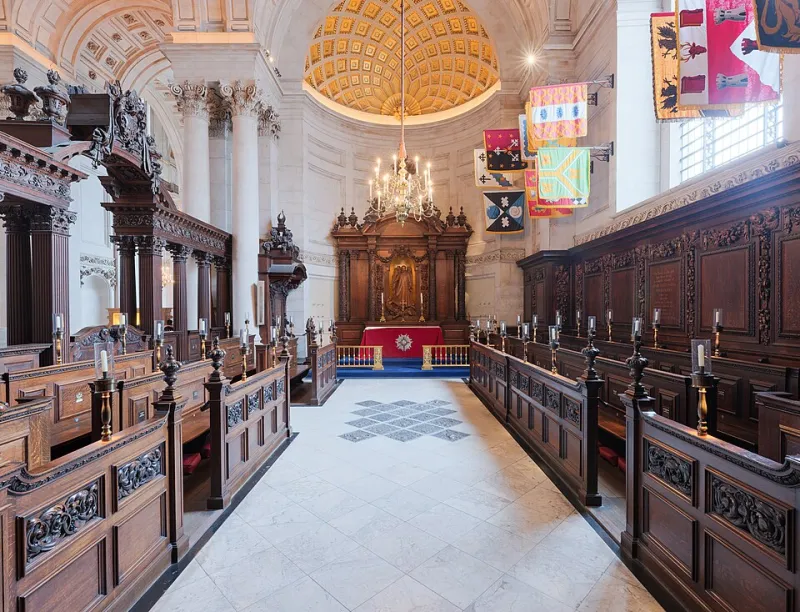
Photo: Diliff, CC BY-SA 3.0, via Wikimedia Commons
The City of London has a reputation for being flat, and it survives because most people experience it from a bus window or the Central line. On foot, at a looking-around pace, the Square Mile turns out to be a landscape: three low ridges with shallow valleys between them, all of it shaped by the Walbrook and the Fleet and then buried under two thousand years of paving. This route treats those ridges as the reason to go out on a Saturday, which sounds like a slightly odd idea until you find yourself halfway up Garlick Hill, able to see the river over a wall.
The route at a glance
- Start: Ludgate Circus (Blackfriars and City Thameslink are both within eight minutes)
- Finish: Tower Hill station
- Distance: about 3 miles / 4.8km
- Time: 2 to 2.5 hours at a stopping-and-staring pace, longer with a pint
- Climbing: nothing dramatic — perhaps 40m of ascent spread across the whole walk
- Steepest pull: Ludgate Hill itself, roughly 300m at a gentle 3 to 4 per cent
- Surface: pavements, kerbs, a few cobbled stretches, plus steps if you take the stairways below
Ludgate Hill: the summit nobody photographs
Everyone photographs St Paul's; almost nobody photographs the ground it stands on. The cathedral occupies the highest natural point in the City, a shade under 20m above sea level at the churchyard, and the whole west front is arranged so the dome reveals itself as you climb out of the Fleet valley. Start at Ludgate Circus, look up, and walk it slowly. The gradient is forgiving but it is real, and it is the reason the Roman road west out of the city — the line Fleet Street and the Strand still follow — bends where it does.
Wren's building is a piece of topography as much as architecture. The dome sits on the ridge, the west towers frame the approach, and the churchyard platform levels off exactly where the ground would otherwise keep rising. Walk round to the north side and look back towards Paternoster Square: you are standing on the top of the City, and from that angle you can see it.
Down into the Walbrook, then up onto Cornhill
Head east along Cheapside and the pavement quietly gives way beneath you. This dip is the valley of the Walbrook, the stream that separated the City's western ridge from its eastern one and which now runs in a sewer under the street carrying its name. It mattered enormously to the Romans: the temple of Mithras went up on its banks, and you can walk into the reconstruction at the London Mithraeum on Walbrook, free, in a basement that still feels appropriately gloomy.
Climb out of the valley and you are on Cornhill, the middle ridge, where the street pattern starts to look like Roman engineering. The forum and basilica sat just to the north-east, roughly beneath today's Leadenhall, and the main east–west road ran along the crest because it was the only sensible line: dry ground, no bridging, a straight run to the bridgehead. St Peter upon Cornhill, on the high point, has a plaque inside claiming a foundation by King Lucius in the second century. A legend, certainly — but the sort of legend that only ever attaches itself to high ground.
Tower Hill and the long look back
East of Cornhill the ground drops again, past the Royal Exchange and down through the streets around Fenchurch, before rising one last time at Tower Hill. It is not much of a hill, 10m or so, but it stands above the old marshland by the river, which is why it was always where you put things you wanted seen: the scaffold, the memorials, the wide sweep of Trinity Square Gardens.
The reward for finishing here is the view west. On a clear afternoon, with the sun low behind you, St Paul's lifts out of the rooftops and you can trace the whole walk back along the ridge line. It is the one spot in the City where the shape of the place is legible in a single glance.
Stairways worth the calves
The level route is fine, but the ridges only really make sense from above, and the City keeps a supply of short, steep flights that most people never use.
- The shallow steps at the top of Peter's Hill, climbing from the Millennium Bridge, put you at close range with the north transept and drop the ground away behind you.
- Beside the Monument, the flight from Lower Thames Street up to Fish Street Hill takes 20 seconds and gives you a grandstand on bridge traffic.
- College Hill and Garlick Hill both haul steeply up from Thames Street to Cannon Street, cobbled in patches and almost always empty. These were the working routes up from the wharves, and they still feel like it.
- Dowgate Hill does the same job a few streets east, with the considerable bonus of a pub at the bottom.
Practical notes
Go on a weekday morning if you want the Mithraeum and the churches open, or a Sunday if you prefer empty pavements and can live with locked doors. Ordinary trainers are fine; the cobbles are the only real hazard. Toilets are scarce — the Royal Exchange arcade and Tower Hill are your best bets. For a pit stop, the Counting House on Cornhill is a grand converted banking hall, while the Hung, Drawn and Poultry on Great Tower Street does the job near the finish. And if the walk has not convinced you that the City has hills, do it again after dark: these streets tilt in ways you cannot ignore when you cannot see them.