Seven Quiet Yards: A Sunday Stroll Through the City's Sleeping Burial Grounds
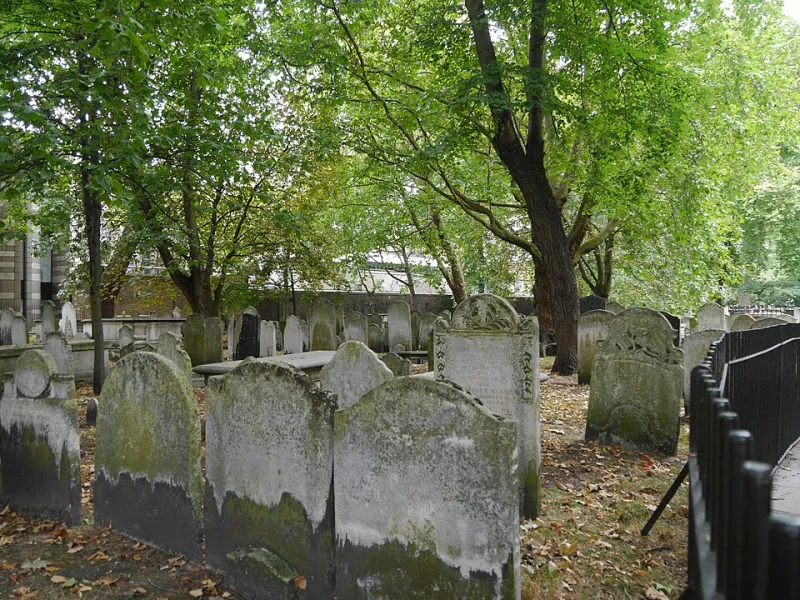
Photo: Edwardx, CC BY-SA 3.0, via Wikimedia Commons
The City on a Sunday morning is a strange, soft place. The offices are shut, the pavements are wide, and the churchyards that sit in the shadow of office blocks are finally quiet enough to notice. This walk is about absence. It visits seven small burial grounds, memorial gardens and nonconformist plots between Tower Hill and Old Street, and it asks a simple question: where did all the graves go?
The route at a glance
- Start: Tower Hill station
- End: Old Street station
- Distance: about 2.5 miles
- Time: 90 minutes, longer if you read every plaque
- Map, in words: Tower Hill to St Dunstan-in-the-East, then Hart Street for St Olave, Aldersgate Street for Postman's Park, Aldermanbury for St Mary Aldermanbury Garden, London Wall for St Alphage Garden, Fore Street for St Giles Cripplegate, and finally Bunhill Fields before Old Street.
- Pub stop: The Old Fountain on Baldwin Street, a short walk from the end.
Treat these places as burial grounds, not picnic spots. Keep to paths, do not climb on grave ledges, and keep your voice low. Curiosity is welcome; noise is not.
1. St Dunstan-in-the-East
Start with the most theatrical of the seven. St Dunstan-in-the-East has a churchyard that feels like a secret garden, with ruins, ivy and a tower that survived the Blitz. The church was old before the Great Fire, rebuilt after it, and then badly damaged in 1941. What remains was turned into a public garden in the 1970s. The graves are not all gone, but the churchyard has been reshaped by bombing, clearance and garden-making. It is a good place to begin because it shows how a burial ground can become a memorial without ever announcing itself as one.
2. St Olave Hart Street
St Olave Hart Street is a small, stubborn survivor. The churchyard is tiny, and the skulls over the gate give it the nickname St Ghastly Grim. Samuel Pepys worshipped here and is buried in the church. The parish was hit hard by the plague in 1665, and the churchyard was closed for new burials in the 1850s as part of a wider attempt to stop overcrowded city graveyards. Some stones remain, but the ground has been lifted and relaid more than once. Stand at the gate and look at the layers: church, churchyard, street, office block.
3. Postman's Park
Postman's Park is a memorial garden rather than a working churchyard, but it belongs on this walk. It was created in the 1880s on the site of the churchyard of St Botolph Aldersgate and the burial ground of Christ's Hospital. The Watts memorial, with its ceramic tablets to ordinary people who died trying to save others, is the reason most people stop. The graves are largely gone, replaced by lawns and benches. It is a good reminder that a burial ground can be cleared and still hold memory.
4. St Mary Aldermanbury Garden
St Mary Aldermanbury is one of the City's great disappearing acts. The church was destroyed in the Great Fire, rebuilt by Wren, then bombed in the Blitz. In the 1960s the remains were moved to Fulton, Missouri, where they were rebuilt as a memorial to Winston Churchill. The garden left behind is quiet and easy to miss. It also has a Shakespeare connection: John Heminges and Henry Condell, two actors who helped put together the First Folio, were parishioners. The churchyard is now a garden, and the graves are part of the ground rather than a row of stones.
5. St Alphage Garden
St Alphage Garden sits against a piece of the old London Wall, which makes it feel older than the surrounding office blocks. The church of St Alphage was damaged in the Blitz and later demolished; the garden keeps the name. This is a good place to think about how the City treats its dead. The churchyard was closed, the church went, the site became a garden, and the wall stayed. The graves are not visible, but the ground is still consecrated in memory if not in law.
6. St Giles Cripplegate
St Giles Cripplegate is a proper churchyard, with stones and a wall and a sense of enclosure. John Milton is buried in the church, and the churchyard has been used, closed, reopened and reshaped over centuries. The church was badly damaged in the Blitz and restored after the war. The graves around it are a reminder that the City's dead were not all swept away; some stayed, but the ground around them changed. Look at the edges of the churchyard where old stones meet new paving.
7. Bunhill Fields
Bunhill Fields is the exception: a nonconformist burial ground just beyond the City's edge, closed in 1854. John Bunyan, Daniel Defoe and William Blake are buried here, and the ground is still full of stones. It is not a churchyard in the strict sense, but it is the best place to end a walk about disappearing graves. Nonconformists were buried outside the established church's grounds, and Bunhill became the great cemetery for dissenters. The stones survive because the ground was kept, not because it was fashionable.
Why the graves went missing
The short answer is overcrowding, legislation and bombs. City churchyards were packed by the early 19th century, and the Burial Acts of the 1850s began to close them to new burials. Some graves were moved, some were covered over, and some were simply left under lawns. The Blitz destroyed churches and churchyards, and post-war redevelopment cleared more. A few sites became gardens; others became office foundations. The City's dead are still there, but often under grass, paving or a memorial plaque rather than a stone.
Practical notes
- Go on a Sunday: the City is quieter and the churchyards are easier to respect.
- Check openings: some churches and gardens have limited hours. Bunhill Fields is open daily, but check before you travel.
- Photography: no flash in churchyards, and never photograph people without asking. Some stones are fragile; do not lean on them.
- Pub stop: The Old Fountain on Baldwin Street is a proper end-of-walk pub, close to Old Street station.
- Allow extra time: 90 minutes is brisk. If you want to read the Watts memorial properly, give yourself two hours.
These seven places are not attractions in the usual sense. They are pauses in the City's fabric, and they reward a quiet, slow visit. Walk gently, look closely, and leave the dead to their sleep.