The City’s Tiny Arrows: A Benchmark Hunt from London Bridge to Clerkenwell
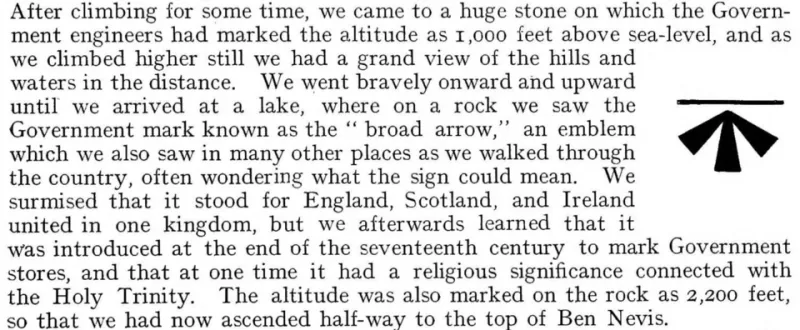
Photo: AnonymousUnknown author, Public domain, via Wikimedia Commons
London has a habit of hiding its history at shin height. You can walk past a thousand stories while staring at your phone, and one of the city’s most understated archives is exactly that sort of thing: small chiselled arrows, metal plates and bolts fixed to stonework, quietly recording how high the ground beneath you sits above the sea.
This is a walk for people who like looking up, down and rather too closely at walls. It runs from London Bridge into the City and finishes in Clerkenwell, following the kind of marks that helped Victorian surveyors turn a messy, uneven country into a map you could trust. No special kit is required — just decent shoes, a phone camera and a willingness to stop dead in the pavement and squint.
What exactly are you looking for?
The classic Ordnance Survey benchmark is a cut mark: a horizontal bar with a broad arrow beneath it, chiselled into stone or brick. Some marks are flush brackets — metal plates, often with a number — while others are bolts set into walls. They were part of a levelling network, a way of fixing exact heights across the country so that maps, railways, reservoirs and all the rest of it could be planned with some confidence.
The Ordnance Survey began in 1791, and its work in and around London has left marks from the 19th and 20th centuries scattered across the built environment. Not every arrow is an OS mark, mind. Government property often carried a broad arrow, and utilities and builders had their own signs. The pleasure is in the looking, not in pretending you can identify every scratch.
Start at London Bridge: check the edges
Begin at London Bridge station and head for the bridge itself. Bridge parapets, abutments and the walls around St Magnus the Martyr are all worth a slow circuit, though you will need to keep an eye on crowds and keep the pavement clear. The current bridge is a 20th-century replacement, so any marks here are part of a layered story rather than a single Victorian one. That is part of the fun: London rarely gives you a clean chronology.
From the bridge, cross into the City and drift up King William Street. Keep your eyes at knee and shoulder height. Benchmarks are often on church towers, boundary walls, station walls and the corners of old commercial buildings — anywhere a surveyor could get a stable fix without causing a fuss.
Monument, Bank and the City’s stonework
Pause around Monument and the lanes behind it. This is dense, busy territory, so treat the walk as a series of short detours rather than a rigid procession. Look for cut marks on the lower courses of stonework, especially where a building meets the pavement. Flush brackets tend to sit a little higher, sometimes on pillars or gateposts.
Carry on towards Bank and Threadneedle Street, then weave west towards St Paul’s. The City is generous with old stone, but it is also a place of rebuilding, cleaning and repair. A mark that looks ancient may be a later copy; a wall that looks Victorian may hide something older. The benchmark is a clue, not a conclusion.
Smithfield and the turn north
From St Paul’s, head north-west towards Smithfield. This stretch gives you a change of texture: churchyard walls, gateposts, old hospital boundaries and the edges of market buildings. It is also a good place to practise your close-up photography, because the stonework is often more varied than the smooth Portland stone of the City’s grander streets.
Look for the horizontal bar first, then the arrow. Sometimes the arrow is worn almost smooth. Sometimes the mark has been painted over so many times that it looks like a shadow. A small torch or your phone’s torch can help in dull weather, but do not scrub, chalk or scrape at a mark. These are part of the historic fabric, and the pleasure is in finding them as they are.
Finish in Clerkenwell
Push on through Farringdon towards Clerkenwell Green. The streets here feel narrower and more workshop-like, and the walls have a lived-in grain that suits a benchmark hunt. Finish with a slow loop around the green and the surrounding lanes, checking gateposts, church walls and the lower edges of old buildings. Then reward yourself with a coffee or something stronger. You have been staring at masonry for two hours; you have earned it.
Practical route notes
The full route is roughly three miles and will take two and a half to three hours at a curious pace. Start at London Bridge station and finish near Farringdon or Clerkenwell, both of which have good onward transport. Weekends are ideal because the City is quieter, though some lanes can still be busy with brunch crowds. Wear comfortable shoes, bring a phone with a macro mode if you have one, and keep an eye on traffic and cyclists when you stop.
Do not touch the marks with anything abrasive, and avoid blocking doorways or pavements. If you want to record a mark, photograph it in context first, then close up. A side-on angle in low sunlight will reveal the cut far better than a flat, head-on snap. Include a nearby brick or street sign for scale, and avoid flash where it will bounce off metal plates.
Why bother with tiny arrows?
Because they turn the city into a detective story. A benchmark is a small, stubborn fact: this point is this high. Around it cluster questions about maps, levelling, insurance, railways, drainage and the ordinary business of making a modern city work. You do not need to answer them all. You just need to look down occasionally, and let London surprise you at ankle level.